President Trump repeatedly calls the accusations that he or his campaign colluded with elements of the Russian government to influence the 2016 presidential election "fake news", "made up", and "an excuse for losing an election". To be clear, no one is saying that Russia "hacked the election", that is, actively changed votes or "erased" votes for Secretary Clinton. What has been said, is that several agencies within the intelligence and law enforcement community, including the Director of National Intelligence, representing all 17 agencies, have concluded that Russia attempted to interfere in our presidential election by hacking into the databases of both the Republican and Democratic National Committees, as well as the emails of the Clinton campaign and the election databases of several states. The analysis was high confidence, which means, to us laypersons, that they didn't just pull it out of their asses. This is longer even arguable, despite President Trump's varied and often contradictory statements about their assessment. Trump, without any basis for his statements, has cast doubt on what his combined intelligence agencies have concluded.
Emails and other information obtained by Russian operatives was subsequently leaked via Wikileaks, but only information that was damaging to the Clinton campaign and the Democratic Party. All the while this was going on then-candidate Trump, who regularly accuses others of precisely what he is guilty of, was railing about how the election was rigged against him.
Little by little information came to light about Trump campaign officials and advisors who had off the books meetings with Russians and then either lied about it or neglected to report it when required to. Michael Flynn, who was nominated and confirmed as National Security Adviser, despite his loose cannon, conspiracy theorist ways that got him fired as head of the Defense Intelligence Agency (DIA), not only improperly met with Russian officials, but lied to the FBI about it and received $45,000 from the Russians for a speech, also not reported. Son-in-law Jared Kushner, Attorney General Jeff Sessions, former campaign manager Paul Manafort and personal lawyer Michael Cohen all had suspect contact and...you guessed it...lied about it or concealed it. Trump himself denies that he has any business dealings in Russia, but his son Donald Junior is on record as saying that they do a disproportionate amount of business with Russia. And now we find out that Donald Junior took a meeting with a Russian lawyer who gained access to him because she claimed to have some dirt on Clinton. Again, concealed until he found out that the New York Times was going to publish his emails.
And let's not forget that James Comey was fired as FBI Director, Trump yucking it up with the Russian Ambassador the next day about what a "nut job" Comey was, and how his firing took the pressure off with regard to the Russian investigation. As the Deputy Attorney General appointed a special counsel to spearhead the investigation, Trump to took to Twitter to denounce the move as a witch hunt.
And the latest - Trump initially denies bringing up the election interference to Putin, until Tillerson says that he did. Then Trump "pressed" Putin, taking his word that Russia didn't interfere, adding "you know my opinion". How can we believe that Trump was forceful with Putin when Trump has cast doubt on what our own intelligence analysts have concluded? Then Trump announces that he wants to set up a joint "impenetrable" cyber-security unit with Russia , although he backpedaled the next day.
Everything that Trump says reminds me of a little kid who lies, but lies badly, not knowing what a plausible lie sounds like, because no one has ever had the balls to call him on his bullshit before. He accuses, not only his opponents, but the press and even the investigators, of being out to get him; he throws wild accusations around, many which make no sense and are often in the category of "he did it, so it's okay that I did it".
There might be nothing underneath all of this, it might just be the gang that couldn't shoot straight, a bunch of incompetent neophytes. But then again, there's an awful lot of smoke for there not to be a fire.
Tuesday, July 11, 2017
Sunday, July 2, 2017
Fake News & Bias in the Media
Since I'm using the word "bias" in the title, I want to emphasize that a person who exhibits bias is "biased", you don't (or aren't supposed to) say "That person is bias". Okay - done with the grammar lesson!
I don't think that it's arguable that there's bias in the media. When I say "bias" I'm not talking about "spin", or willfully misrepresenting facts, I'm referring more to the below-the-surface inclinations that we all have to emphasize one thing over another, to prioritize what's important and what's not. Decisions have to be made at every newspaper, television and radio station or internet blog about what gets covered and in how much depth. Much was made last week of a CNN employee who gave his opinion that a certain story was being pursued because of ratings. Why would the fact that ratings factor into corporate decisions surprise anyone? If news organizations continually feature content that nobody is interested in, pretty soon they will be defunct news organizations.
I'm not a journalist, nor have I ever been one. I worked for a newspaper for twelve years back in the nineties, but not in a reporting capacity - I was a circulation manager - we made sure that the paper that the reporters and editors worked so hard to put out and the advertising department worked so hard to pay for got delivered to the people who wanted to read it. I knew some reporters back then and know a handful of journalists now, and I don't know any for whom the truth isn't paramount and make an effort to report accurately, overcoming their own personal biases. But what about the big, bad corporations? Sometimes they get it wrong. Sometimes individuals within those corporations act unethically. Sometimes they jump the gun and have to backtrack or retract stories. But for these organizations, their reputation is all important. Their reputation for getting it right. Their reputation for digging up information that those in power are trying to hide, for exposing corruption.
And mostly they do get it right. For all the accusations from the Trumpists that the mainstream media is corrupt, fraudulent and biased, they generally get it right. Pressed, Trumpists usually fail to come up with any concrete examples.
Then there's the term "Fake News". Initially the term referred to bloggers or commentators who literally made up news that they knew was false in order to further an agenda or affect a political race. The term was quickly co-opted by President Trump to describe any news organization that had the temerity to publish stories that painted him in an unflattering light. He escalated to calling out individual news organizations and then individual reporters. On at least one occasion he referred to the mainstream media as "the enemy of the people". As if it wasn't bad enough that a paranoid president, lashing out at his enemies, tweets out conspiracy fantasies, but the legions of Trumpists who automatically disbelieve everything from the mainstream media and reflexively swallow everything that Trump says, indicates the willful ignorance that is infecting this country.
There is a reason that freedom of the press is included in the first amendment. For all the chest beating about The Constitution from the Trumpists, for all that the second amendment is equated with Holy Writ, they don't seem to have much respect for the freedom of the press and the important part that a free and unfettered press plays in maintaining the other freedoms that we hold so dear.
I am not suggesting that we should, without question, believe everything that we see or hear in the media. What I am suggesting is that we shouldn't disbelieve everything either. What we should do is use our reasoning faculties and weigh the evidence. We should stop assuming that every reputable news organization is out to get the President and is willing to lie and invent "facts" in order to make him look bad.
Sunday, June 25, 2017
Affordable Healthcare?
The biggest beef that I hear about the ACA, aka Obamacare, is that premiums have gone up astronomically. But the question that no one ever asks is "What would the premiums have been before the ACA?" Well, I looked at what I was paying for group insurance through my previous job. Monthly premiums were $418, which included dental. As a store manager, I could afford this premium, but what about people at the lower end of the pay scale? A typical wage was around $10/hour. At that rate, take home pay before taxes would be approximately $1078/month. take health insurance from that and they're left with $660/month to pay rent, but groceries, put gas in the car, pay utilities and phone bills in addition to car insurance and any other expenses. It's easy to see that even for a group insurance policy, insurance wasn't affordable for many people, and they went without. If group insurance was that out of reach for lower income people, what about individually purchases insurance? When I lost my job 18 months ago I had the option of continuing my insurance through COBRA coverage, without dental, but all other coverage the same, my premium was $761/month. Of course there were plans that you could purchase for less, with almost useless coverage and high deductibles - these were the types of plans that were outlawed under ACA.As I mentioned in a previous post, the problems that need to be fixed are pricing related, and part of that problem is that the risk isn't spread out enough. I recently had an accident with my car. Like everyone who drives a car, I have insurance. I don't have to worry about not getting my car repaired because I have coverage that I can afford. But what about low income people? All of them have car insurance as well. Why? How can they afford it? Because they don't have a choice. If you want to register your car, you have to be insured. Even if you don't have a lot of money, you figure it out because there is no other option. And because everybody who owns a car has to have insurance the risk is spread out. You may never make a claim, but you still have to pay your premiums.
There are solutions to the problems of affordability in the health care world, we don't have to solve them by ensuring that millions are uninsured and enriching the already rich.
Tuesday, May 30, 2017
Republic vs. Democracy
In the immediate aftermath of the most recent Presidential election, President-elect Trump repeatedly crowed about his "historic" win. His utterances suggested that he thought that he had won a broad mandate. His detractors often pointed out that despite winning the election, his main opponent had received more votes. Trumpists, after trotting out a map purporting to show how many counties had received a majority of Trump votes, would respond that "this is a Republic, not a Democracy", as if that explained why we had an electoral college.
I have heard the supposed difference between democracies and republics "explained" to me numerous times over the years, and by "explained" I mean "shouted at me", usually with an admonition to "educate myself". For these people a Democracy is nothing more or less than a Direct Democracy, i.e. "Mob Rule", while a Republic is a government by elected representatives who are guided by a constitution. This is partially true.
"Republic" comes from the Latin Res Publica, "a matter of the people", whereby the government is a public matter and not the private property of a monarch. In other words, in the strictest interpretation, a republic is simply "not a monarchy". The form that a republic can take is quite varied. In the United States, most people who refer to republics are talking about a representative-constitutional government, whereby the executive and legislators are elected by the people for fixed terms and are guided by laws, in our case, a constitution. However who "the people" are can be circumscribed quite broadly. In the early days of the United States only adult, white, male, landowners were permitted to vote. This eventually gave the way to voting rights for all adults, except some felons. In a Socialist, or Communist, Republic, the will of "the people" is assumed to reside in the ruling party, which has elections, but decides ahead of time who may run. In an Islamic Republic, the Quran and the clergy empowered to interpret it decide what's good for the people. Ancient Greek republics limited voting to a citizen class. But even if we accept that the correct or true form of a republic is an elected representative government bound by a constitution, that does not makes democracies and republics mutually exclusive.
"Democracy" literally means power or rule of the people. The simplest form of this is Direct Democracy, often referred to as "Mob Rule", where every decision is voted upon by everyone. Obviously this could only work in very limited situations, such as (very) small towns, or people in small isolated groupings. Direct Democracy almost never exists. A less "pure" form of democracy would involve an elected administrator and/or hired technical people who would keep things running, while important decisions would be voted on. The other end of the democracy continuum would be a system indistinguishable from what we defined above as a representative, constitutional republic: you elect representatives for fixed terms, who are then responsible to run the government according to a constitution. Those who are careful about their words refer to this as a democratic republic, or just a democracy for short. Nobody who calls the United States a democracy really believes that it is a direct democracy or thinks that a direct democracy is a good thing for a large nation.
Nothing about a Democratic Republic, whether you emphasize "democracy" or "republic", guarantees that a system like the Electoral College will exist, or is the ideal system. Various representative democracies/democratic republics use various methods for choosing their head of government, or head of state. Most directly elect their president or prime minister through popular vote. In some countries, notably in the United Kingdom, the Prime Minister is the leader of the party which wins a majority of seats in the House of Commons. We have the system that we do, not because we're a republic, or even strictly because we have a federal system, but because of various compromises arising from competing priorities among the various states. Predominant issues included slavery, small state versus larger states and the tendency for the states to view themselves as sovereign.
Nothing about being a republic guarantees that a tyranny of the majority, the mob rule that detractors of the term democracy so fear, cannot take root. Majorities can still elect representatives that will abuse minorities, and the representatives can be cowed by fear of not being re-elected. What gives the minority rights and protections are the rights and protections that we wrote into our laws early on, such as the Bill of Rights and separation of powers.
Yes, it's important to use our terms accurately, but insisting that our republic is not a democracy is insisting on a distinction without a difference.
Wednesday, May 24, 2017
My Problems With Trump
On November 9th I asked whether we were supposed to just forget all the hate and vitriol as President-Elect Trump sounded so calm and "Presidential" while showing grace and courtesy to Secretary Clinton and President Obama. He was elected in part by taking advantage of latent racism, bigotry, xenophobia and misogyny among many American voters and I was not in the mood to pretend that this man was going to be a reasonable, rationale, sober leader. It didn't take long for Trump to tire of acting reasonable and rational and take to Twitter with his ill-informed opinions and unsubstantiated accusations.
During the campaign I thought most of what Trump was proposing, if bellowing out applause lines can seriously be considered proposing, was unrealistic (The Wall), and the rest was just what normal Republicans were going to do anyway (Repeal PPACA). I didn't believe that he knew what he was talking about, or had put any serious thought it the how of any of his ideas. I thought his ignorance of virtually all facets of governance was his biggest downside.
As he started to "get to work", if a four eight hour days followed by a golf weekend can be called work, I was unhappy with his executive orders, but was not surprised, after all, eliminating regulations was an old Republican standby. There's certainly an argument to be made about how harmful his executive actions are, and how his cabinet picks, people who don't believe in the mission of their departments, could be characterized as re-filling the swamp, rather than draining it.
His obsessive jihad to eliminate the PPACA also wasn't surprising, in that the Republicans had been threatening to do it for eight years and he had been shouting about it throughout his campaign, and I shouldn't have been surprised that he had no idea what was actually in the so-called replacement bill. It goes right along with his general ignorance.
The two things that disturb me the most about Trump are (1) his demonizing of the press and (2) the apparent collusion with Russian in influencing the election and his attempts to end the investigation.
Trumpists, and Trump himself, put a lot of stock in the Second Amendment, but support for the First seems to be conditional. Say what you want about bias in the press, a free media, while not a branch of government and outside the constitutional system of checks and balances, often acts as an unofficial check and balance against government overreach. How many examples of government skulduggery has been exposed by a newspaper that just wouldn't back down? An independent media is one of the first things to go in a dictatorship.
Trump, almost from Day One has made it his mission to sow distrust in the mainstream media and portray media outlets as liars who use nonexistent sources and make up stories to make him look bad. He regularly calls major newspapers and television news "fake news" and has declared them "the enemy of the people". Among his followers, anything that he says is to be accepted without question, despite his easily documented lies about virtually everything, while anything from the mainstream media is "fake news". His evident goal is to discredit independent reporting, so that Trump and only Trump will be the source of what is true about Trump.
The second disturbing thing about Trump is the Russia investigation. At first it was simply about hacked emails and fake news reports. That didn't seem so bad. No one was suggesting that voting machines were tampered with, just that Russia had interfered, or attempted to do so. But after a while it seemed like every week, or even every day, another Trump associate turned out not only to have ties with Russia, but had lied about it. And now we have Trump firing the head of the FBI in the middle of the investigation, and said former FBI Director claiming that Trump tried to get him to back off and intelligence directors also testifying that Trump tried to get them to get the FBI to end the investigation.
If this is a "made up story to create an excuse for losing the election" why the cover-up?
Tuesday, May 2, 2017
Trumpian Logical Fallacies: Ad Hominem
Ad Hominem is one of Trump's go-to arguments: his opponent isn't wrong because of what they say, he or she is wrong because of who they are. This is a classic playground maneuver, pin a humiliating nickname on someone, repeat it often enough, and that nickname becomes that person. "Low Energy" Jeb, "Little" Marco, "Lyin'" Ted, "Crooked" Hillary. He flung these epithets around so often that he was spared the trouble of actually making the case that his characterizations were true.
During the primaries I saw an egregious example of how his ad hominem attacks had, for many of his supports, become the truth. Ted Cruz, a politician who I harbor no warm and fuzzy feelings, was leaving a campaign event and encountered a group of Trump supports. Cruz politely, and apparently sincerely, attempted to engage them in conversation. The spokesman for the group could not articulate why he supported Trump over Cruz, but merely repeated, over and over the insulting label "Lyin' Ted". The Trump supporter could not, when pressed by Cruz, give any examples of lies that Cruz told. Eventually Cruz walked off.
The ad hominem that seems to have the most life in it is the term "fake news" or "fake media". Trump took a term that had been applied to fringe web sites and to partisan outlets that purposely planted false stories, and applied it to legitimate news sources. Trump, like his name-calling toward individuals, provides no evidence of the "fakeness", but he just keeps saying it, over and over until his hardcore supporters believe it.
By all, means, if someone is lying, call them on it, if what's in the news is false, speak up, if an opponent has bad ideas, counter them with good ones, but to make a decision or form an opinion based on a schoolyard insult is just lazy.
Trumpian Logical Fallacies: The Strawman
President Trump regularly attacks straw versions of his political opponents, rather than those opponents themselves. Trump's campaign rallies last year and his Twitter feed this year are full of misrepresentations of what other people actually stand for. One example from the campaign was Trump's assertion that Clinton was going to eliminate the Second Amendment. Of course it's a no-brainer for Trump's base to be against someone who wants to actually take away a part of the Bill of Rights. Except that wasn't Clinton's position at all.
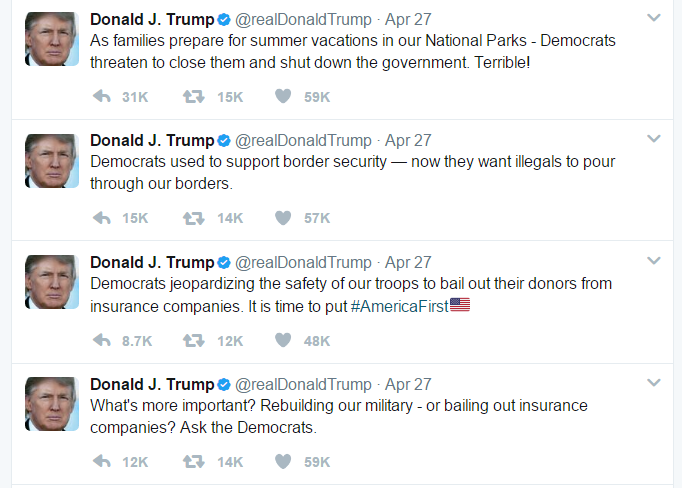
A couple of days following Trump on Twitter will provide numerous examples of the strawman fallacy. Trump, in this series of tweets has suggested that the Democrats are the reason that we are staring a government shutdown in the face. He is ascribing motives and actions to them that don't exist in order to attack them. I will concede that Trump's ramblings are so full of logical fallacies, that it may be difficult to isolate a statement and link it clearly to one fallacy. Ad hominem attacks play a big role in his public statements, as does appeal to fear and bandwagon fallacies. What they all have in common is that his arguments are all talk and no substance. So, the question that you want to ask while cheering Mr. Trump's attacks on the Democrats, on immigrants, on the news media, for their sins, is: is what he's saying that they're doing actually what they're doing?
Subscribe to:
Posts (Atom)